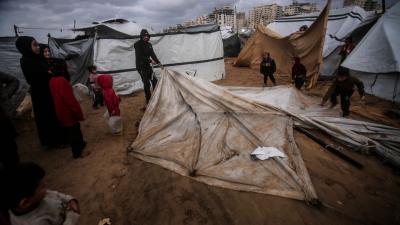
The wet tent syndrome… a daily tragedy for thousands of displaced people in Gaza
749
Displaced people in the Gaza Strip are enduring long, cold nights in dilapidated tents without heating or any real means of protection. This coincides with the near-total collapse of the service and health systems in the besieged territory.
Hundreds of thousands of Gazans have found themselves forced to live in flimsy tents after the Israeli occupation destroyed their homes, subjecting them to one of the harshest chapters of human suffering. These tents, once temporary shelters, have become a source of danger, threatening their lives. With the onset of winter and the rains, water seeps into the tents, turning the floors into mud and spreading disease, especially among children and the elderly.
Reports issued by the Government Media Office in Gaza indicate that about one and a half million people in the sector are currently living without shelter as a result of the widespread destruction of homes during the Israeli aggression. These people urgently need about 288,000 caravans or mobile homes as a minimum to provide temporary humanitarian shelter that protects them from the elements and constitutes a realistic alternative to tents that are no longer suitable or sufficient to respond to the scale of the disaster.
The Dean of the Faculty of Health Sciences at the Islamic University of Gaza, Abdul Raouf Al-Mana’ma, warns of the worsening health crises among displaced people with the onset of winter, specifically what is known as “wet tent syndrome.” This syndrome is a group of illnesses that arise from prolonged residence in environments lacking even the most basic necessities for healthy shelter. It is often observed in war zones and disaster areas and serves as an indicator of deteriorating housing conditions and a heightened level of risk.
Al-Mana’ma explains that “this syndrome is not a specific disease, but rather a health condition resulting from forced living in extremely harsh conditions. These conditions include extreme cold, constant dampness, and poor ventilation inside tents, in addition to the near-complete collapse of health services. This leaves residents vulnerable to a wide range of illnesses and health complications. The illnesses associated with this syndrome include respiratory diseases, which are the most widespread and serious. These include recurrent upper respiratory tract infections, bronchitis, pneumonia, and asthma, as well as an increase in viral infections. Hospitals are currently witnessing a sharp rise in the number of children suffering from shortness of breath and coughing.” He adds: “The widespread prevalence of skin diseases is evident within this syndrome, including fungal infections, impetigo, rashes, and chafing, resulting from constant dampness and the inability to change clothes or bathe, especially among children. There are also problems related to immunity and nutrition, as the extreme cold and malnutrition contribute to weakening the population’s immunity, making them more susceptible to infectious diseases and prolonging recovery time. The serious psychological and social effects cannot be ignored, including sleep deprivation, anxiety, and depression, along with a constant feeling of insecurity and lack of privacy. The groups most affected by this syndrome are young children, the elderly, pregnant women, patients with chronic diseases, and people with disabilities, who experience health complications more quickly.”