
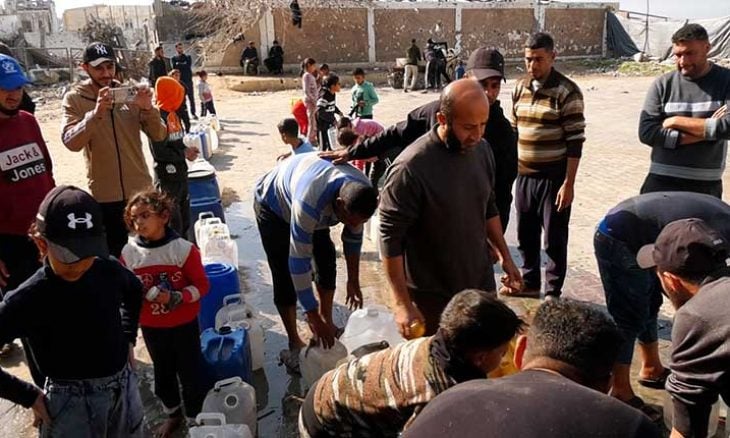
Water crisis suffocates northern Gaza… scarcity and thirst
Khaled al-Amoudi never imagined that his return to northwest Gaza, after months of displacement, would be so burdened by thirst.
Every morning, the 35-year-old stands in front of his tattered tent, scanning the clouds and the muddy roads, before embarking on a grueling search for water—a journey that has become part of his harsh daily life in an area still haunted by the war, despite the ceasefire agreement being signed nearly four months ago.
Al-Amoudi says the water crisis has become the most prominent feature of the suffering of displaced people in the northern Gaza Strip, explaining that the scarcity of drinking water and water for daily use forces them into a life akin to forced survival. “To get regular water for bathing and washing, we have to walk two full kilometers from our location in northwest Gaza,” Khaled told Al-Quds Al-Arabi, pointing to the dirt road he travels daily carrying empty plastic containers.
The suffering isn’t limited to the distance; the area where Khaled pitched his tent lacks even the most basic infrastructure. With the onset of winter, the tents collapsed one after another due to the torrents of sewage that flooded the area. “There are no sewage systems, no paved roads, and even the existing roads are either closed or destroyed,” he says, emphasizing that the area is completely marginalized in terms of services, especially water.
What’s even more heartbreaking, according to Khaled Al-Amoudi, is that the return to the north has not been met with any real humanitarian response. “Since we returned three months ago, no one has paid any attention to us. The tents are dilapidated, the infrastructure is destroyed, and there is absolutely no water or aid,” he adds, his voice heavy with exhaustion. He points out that this reality is what drives many displaced people in the southern Gaza Strip to ask: Why should we return to the north when there is no water and no basic necessities of life?
As the war’s repercussions continue, the water system is suffering near-total paralysis due to widespread destruction of infrastructure and disruptions to supplies and maintenance, making clean water a scarce commodity for residents. According to the Gaza Municipality, approximately 85% of the Gaza Strip’s population lacks access to clean water, while water services are operating at a 75% deficit, marking one of the worst crises the city has faced in decades. These figures reflect not only a technical deficiency but also a humanitarian crisis impacting the daily lives of every Palestinian family.
The post Water crisis suffocates northern Gaza… scarcity and thirst first appeared on - dailyyemen.