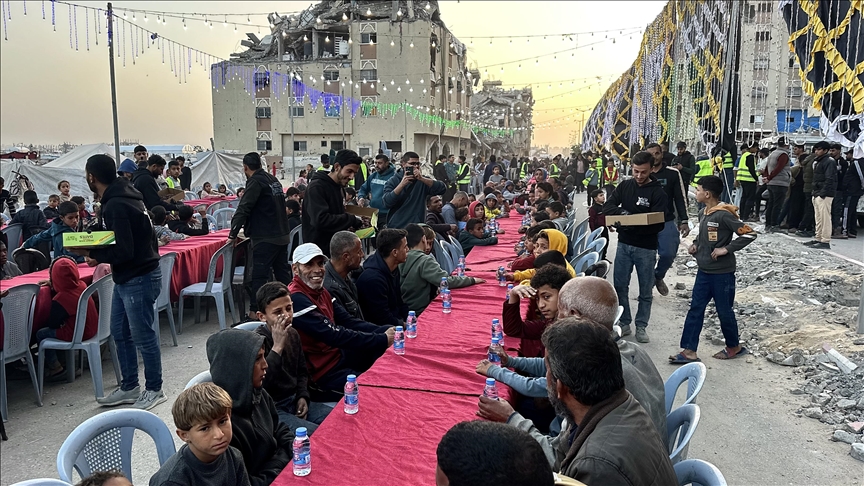
Amidst the rubble and tents, Gaza welcomes Ramadan with communal meals
998
On the first day of Ramadan, charities and organizations set up communal iftar meals in devastated neighborhoods of the Gaza Strip, amidst the rubble of buildings shattered by Israel’s two-year war of genocide.
On both sides of roads strewn with massive amounts of debris, charities and organizations erected tables to feed hundreds of fasting people. The area was surrounded by crumbling buildings, and children ran among the concrete blocks that had been their homes until recently.
With American support, Israel launched a two-year genocide in Gaza on October 8, 2013, leaving more than 72,000 Palestinians dead and over 171,000 wounded, most of them children and women. The war also resulted in the destruction of 90 percent of the civilian infrastructure. Despite the destruction of mosques, worshippers performed Taraweeh prayers in mosques that had partially reopened, while makeshift prayer areas were set up inside tents and on the ruins of completely destroyed mosques. In the “Tunnel” area north of Gaza City, the Turkish Humanitarian Relief Foundation (IHH) organized a communal Iftar (fast-breaking meal) for dozens of displaced families.
Saeed Al-Arkan, the foundation’s projects director, told Anadolu Agency: “We are here among the tents and rubble to affirm our attachment to this land. In previous years, we broke our fast in our homes, but today we break it on its ruins to strengthen the resilience of our people.”
With gratitude, Al-Arkan thanked the Turkish people for their support of the Palestinians in the face of the ongoing Israeli war.
In the Jabalia refugee camp in the northern Gaza Strip, the Abu Hussein School hosted an Iftar for hundreds of fasting people, preceded by a gathering of religious chanting and supplications. Ali Battah, coordinator of the Jordanian Campaign (a local relief organization) in Gaza, told Anadolu Agency that the iftar (fast-breaking meal) was held in an area less than 800 meters from the “Yellow Line,” emphasizing that the goal was to convey the residents’ determination to remain on their land and their rejection of displacement.
The so-called “Yellow Line” separates the areas where the Israeli army is deployed, which constitute approximately 53 percent of the Gaza Strip’s area in the east, from the areas in the west where Palestinians are permitted to move.
For his part, Palestinian Fouad al-Malahi told Anadolu Agency that the residents of Jabalia refugee camp are determined to remain despite the destruction and hardships.
He said, “We came today to participate in this iftar to affirm to the whole world that we want to live.”