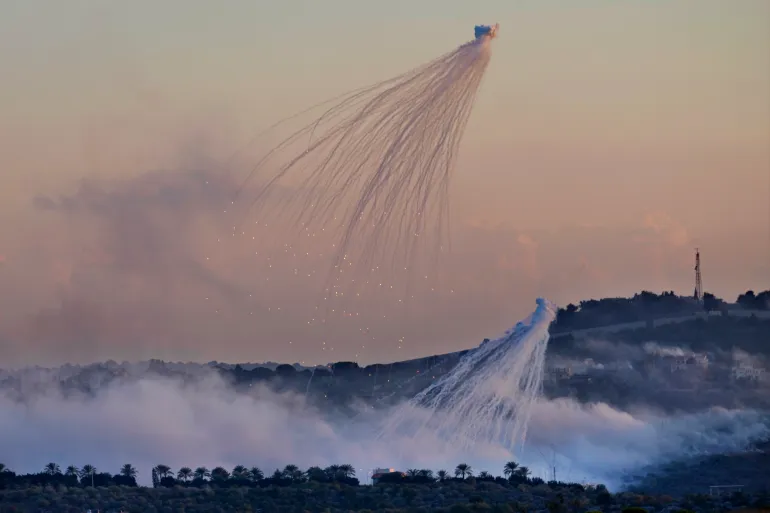
Phosphorus bombing and targeting of ambulances: The specter of Gaza looms over Lebanon
14
The Israeli war on Lebanon no longer appears to be a separate front from Gaza, but rather an extension of the same logic: the bombing of civilian infrastructure, widespread displacement, targeting of medical facilities, and the threat of a new occupation that opens the door to a longer cycle of violence.
British reports indicate that what is happening in southern Lebanon not only reveals an Israeli attempt to weaken Hezbollah, but also foreshadows the transfer of the warfare patterns that characterized Gaza to the Lebanese arena, with all the destruction and disruption of civilian life that they entail, and the expansion of the space within which international law is violated in the name of security.
In this context, an editorial in the British newspaper The Guardian argued that the global focus on the war with Iran has obscured a crucial aspect of the situation: the Israeli war on Lebanon, which, according to the Lebanese Ministry of Health, has resulted in the deaths of approximately 1,100 people and the displacement of a fifth of the population. The newspaper adds that Israel, after responding to Hezbollah’s rocket fire into its territory with what it described as “precise and targeted strikes,” quickly expanded its offensive. Israeli Defense Minister Yisrael Katz then announced the establishment of a buffer zone, or what he called a “defense belt,” extending to the Litani River—a move the newspaper considered a prelude to a new occupation that would be illegal in itself.
The Guardian believes that Israeli rhetoric is shifting from a logic of deterrence to one of control, citing Finance Minister Bezalel Smotrich’s calls for annexation and Katz’s talk of demolishing border homes, as happened in Rafah and Beit Hanoun in Gaza.
In another report, The Guardian highlighted Israel’s use of white phosphorus in southern Lebanon. It stated that Human Rights Watch researchers verified images showing white phosphorus munitions exploding over residential areas in the southern town of Yahmor during the early days of the offensive.
The use of white phosphorus in Lebanon reinforces fears of a scorched-earth policy being applied to a new front (Associated Press).
The report quotes Lebanese researcher Ahmad Beydoun, who documented nearly 250 instances of white phosphorus use by Israeli forces between October 2023 and November 2024. He explained that 39% of these uses occurred in residential areas, 17% in agricultural land, and 44% in wooded or open areas.
Beydoun believes the Israeli army uses this substance to burn fields and create visibility, preventing people or fighters from taking cover under trees. He summarized the concept by saying, “It’s primarily a tool for burning the land.” The report adds that the use of white phosphorus has led to the burning of more than 2,000 hectares of rural southern Lebanon, including 873 hectares of dense forests, with warnings of a long-term impact on soil, vegetation cover and agricultural production.