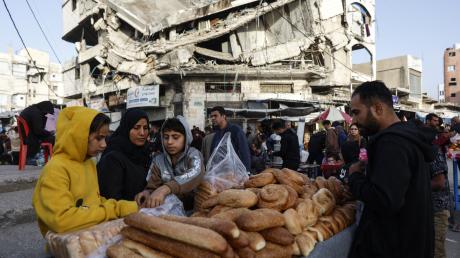
The bread crisis in the Gaza Strip is worsening as the quantities supplied through the World Food Programme have dwindled, leading to shortages and increased demand. This has also prompted a resurgence of bread being diverted and sold on the black market at inflated prices, further exacerbating the suffering of Gazans in their struggle to obtain basic necessities.
Palestinian Saif al-Helou says that obtaining a bundle of bread has become a daily ordeal due to the severe shortages in the markets. He explained that he used to buy a bundle at the official price of 3 shekels (approximately one dollar), but now faces significant difficulty finding it at that price, often forcing him to buy it at a higher cost. Al-Helou told Al-Araby Al-Jadeed that the price of a bundle of bread is no longer fixed but fluctuates depending on the quantities available in the market.
He pointed out that some vendors are selling it at double the price, sometimes reaching 15 shekels per bundle, which is beyond the means of many families who rely on bread as a staple food. He stressed that the crisis was not limited to bread alone, but extended to flour as well, as the price of a bag of flour rose from 25 shekels to 70 shekels, as a result of the scarcity of bread available in the markets, in addition to the decline in the quantities of humanitarian aid that used to distribute flour to the population, which doubled the size of the living burden on families.
For his part, the bread seller in the Nuseirat market in the central Gaza Strip, Fayez Ibrahim, says that the movement of selling bread was directly affected by the current crisis. Only, with a simple and stable profit margin. Ibrahim added to Al-Araby Al-Jadeed that the situation has changed a lot during the recent period, as they are buying bread at varying prices, ranging from 5 to 15 shekels, according to the size of the available quantities and the sources of supply. He points out that they are sometimes forced to sell with a margin of profit not exceeding one shekel or less, in an attempt to maintain the continuity of work and meet the demand, stressing that the absence of sufficient quantities of bread in the markets opens the door to greater price hikes. Ibrahim indicated that if the shortage and lack of supply are severe, some sellers are forced to sell with a greater margin of profit, which is directly reflected on the citizen who finds himself facing volatile and high daily prices.
For his part, Abdul Nasser Al-Ajrami, head of the Gaza Bakers Association, says that the World Food Programme has reduced the amount of bread produced during the current period. He explained that this reduction has directly led to a shortage in the markets, while demand remains unchanged. Al-Ajrami added to Al-Araby Al-Jadeed that this situation has contributed to the resurgence of the black market, where a bundle of bread is now being sold for between 7 and 15 shekels, even though its official price does not exceed 3 shekels.
He warned that the continuation of this situation will exacerbate the humanitarian and living crisis in the Gaza Strip. He pointed out that reducing the amount of bread produced by the World Food Programme, without restarting bakeries and supporting them with diesel and flour, is intensifying and further complicating the crisis. He emphasized that bakery owners are eager for the bakeries to reopen, as this would directly increase bread production and alleviate pressure on the markets.