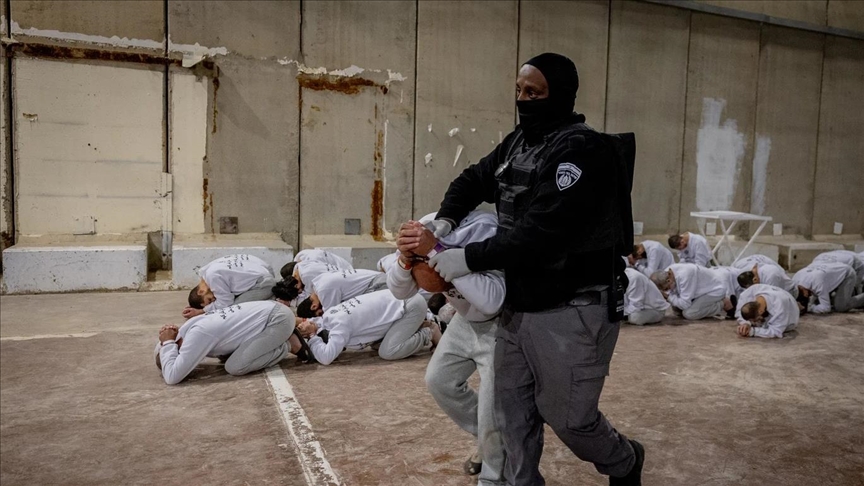
Sexual violence in Israeli prisons: A systematic policy to break the Palestinians
55
Violations within Israeli prisons are not new in the context of the ongoing conflict, but what has been revealed since October 7, 2023, indicates a qualitative shift in the nature of these violations. Among these, sexual violence has emerged as part of a recurring, widespread pattern bearing the hallmarks of organization and planning.
This shift is evident not only in the scale of the incidents but also in their structure. The use of the body as a space for punishment intersects with a closed detention environment that allows for the intensification and perpetuation of violations beyond any effective oversight. This raises a fundamental question: is this a matter of individual transgressions or a policy taking shape within a broader system?
The Euro-Mediterranean Human Rights Monitor issued a report today, Sunday, entitled “Another Genocide Behind the Walls,” which provides initial material for understanding this shift. The report documents recurring patterns of sexual violence, including direct rape, assault with objects, forced nudity accompanied by verbal and physical humiliation, and the presence of multiple security personnel during or the recording of these assaults with audio and video.
The repetition of these patterns across separate testimonies and in different detention facilities does not leave them within the framework of individual incidents, but rather pushes towards reading them as a productive pattern within an institutional environment where violence becomes a repetitive practice and not a passing exception.
In one of the testimonies collected by the documentation team, a 43-year-old former detainee recounts the details of repeated sexual assaults he endured during interrogation. The incidents were not isolated moments but rather a series of prolonged events involving beatings, filming, and mockery, all in the presence of multiple security personnel.
Wajdi, who spent a full year in detention, says he was subjected to direct and repeated rape by soldiers and a dog during his interrogation.
He added: “During the interrogation, they tied me naked to an iron bed, and one of the soldiers asked me how many Israeli women I had raped inside Israel. I denied ever entering Israel. Then a soldier raped me. I felt excruciating pain in my anus, and I screamed. Every time I screamed, I was beaten. This went on for several minutes while the soldiers filmed and mocked me. The soldier left after ejaculating inside me.” He continued: “I was in a humiliating situation, I wished I were dead, and I was bleeding. Later, they untied me and brought in a dog, which also raped me. That same day, I was raped at least twice more after being tied to the bed. One of the soldiers put his penis in my mouth and then urinated on me. The rapes were repeated two days later by three soldiers. I was in a very bad physical and psychological state.”
What this testimony reveals is not limited to the act itself, but extends to the context in which it occurred. The assault appears as part of an interrogation environment that permits and even reuses it as a means of coercion, reinforcing the hypothesis that what is happening is not an anomaly but rather a practice that takes place within it.
The impact of these violations extends beyond the physical realm, reaching what can be described as a psychological engineering aimed at reshaping the victim’s self-awareness and perception of their community. Concepts of dignity and privacy are employed as tools of coercion, instilling the fear that disclosure will constitute a second violation.
In this way, society transforms from a potential source of support into an additional threat, and the victim finds themselves trapped in a vicious cycle of silence, where the effects of the abuse persist even after the initial incident has ended.