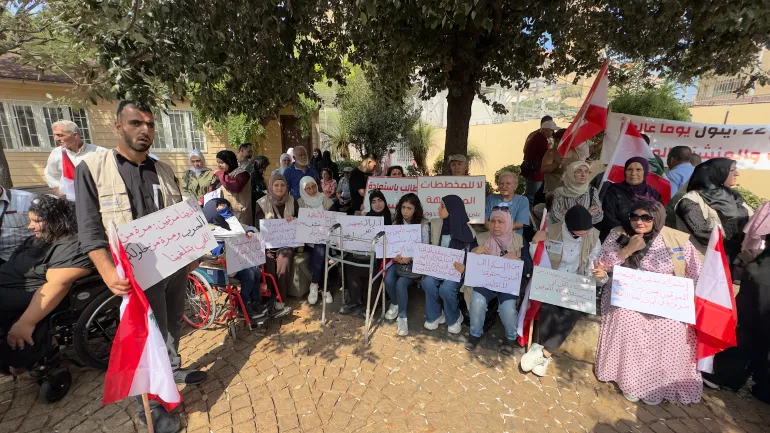
From displacement to rubble: Demands of residents of border villages in southern Lebanon
41
“I wish I were a tortoise so I could have my home on my back,” says Bassam Ibrahim, a Lebanese citizen, summarizing his months of displacement after losing his home and livelihood in the town of Kfar Tibnit in southern Lebanon.
Ibrahim fled his town with his wife and two children under bombardment, leaving behind a house that no longer stands and a workshop where he worked in art and painting. As a person with a disability, displacement was not simply a matter of moving from one place to another. From the very beginning, he faced difficulties in moving around, finding suitable accommodation, and adapting to an environment that doesn’t always consider the needs of people with disabilities. Today, Ibrahim stands in front of the headquarters of the United Nations Economic and Social Commission for Western Asia (ESCWA) in Beirut, alongside residents of southern border villages participating in a civil movement under the slogan, “Enough silence about the erasure of our villages and preventing our return.” His demand is not limited to opening the road to his town; he wants the residents to return to their lands and live a life that allows them to resume their work. For him, returning is not just a move from one place to another, but a restoration of the life that war has cut short. The displacement also prompted Ibrahim to reconsider his future, as he tells Al Jazeera Net that he has lost faith in the parties, the state and the authorities, and is now thinking of selling his olive grove and building a new life in a safer area.