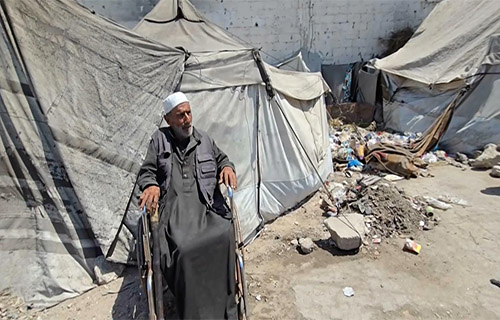
Displacement and illness weigh heavily on the elderly in Gaza
272
“I’m sitting here, spending my days alone without any care after my sons were killed and one of them lost a leg. My daughters are with their husbands; I have no one left except for one son living abroad,” said 80-year-old Fatima al-Harsh, her voice breaking as she described her life in a displacement tent west of Gaza City.
She added, “I always need someone to help me because I can’t get water or food myself. May God reward my neighbors who help me, and sometimes my daughters visit me.” It’s not just the children who suffer from orphanhood. There are also fathers and grandfathers, both men and women, whose hair has turned gray and whose backs are bent, who have lost their support. They spend the rest of their lives in daily isolation, burdened by helplessness and loneliness, waiting for a kind hand and for assistance to knock on their tent doors.
Years after the aggression and the killing of approximately 73,000 people, hundreds of elderly people find themselves living in isolation and deadly loneliness in tents or damaged homes, relying on distant relatives or neighbors for food, medicine, or even a glass of water. The elderly woman, Al-Harsh, sat alone on a plastic chair in a small space in front of a tent erected by her relatives, who had been displaced to a distant area. She explained that she was suffering from the summer heat and limited mobility.
Al-Harsh said that she never left her water bottle, as she needed to drink and required assistance when using the restroom or bathing. She added that she was no longer afraid of the bombing or the war itself, but rather of being alone.
“What pains me most is being alone without anyone to keep me company and talk to,” she said. “Some neighbors visit me when they can, but everyone has their own worries and problems.”
With the widespread collapse of social and health services, these elderly people have become among the most vulnerable groups. Many lack assistance even within the tent itself or to obtain medication from clinics.
Social work specialists saw that the elderly and in general need someone to help them, but the war created exceptional circumstances that made the need to stand by them greater. Some of them lost sons, daughters and grandchildren, and others who lived alone as a result of the displacement periods. The social worker, Abeer Dahmann, who works for an international institution, said that the elderly face overlapping crises, including deprivation of family care, deterioration of mental health, and the high risk of malnutrition, as well as the absence of organized support that guarantees them a decent life. Dahman added: “Those who live in worn-out tents or destroyed houses should not be based on the benevolence of neighbors or distant relatives who come every month or two and for several hours.” And she believed that these people need help by providing them with projects and service programs through field teams that visit them in their places on an ongoing basis, or to provide health displacement centers suitable for their needs, such as those with disabilities, especially those who have lost their relatives. First class.