In Gaza, winter is no longer a season, but rather a death sentence for childhood
1,216
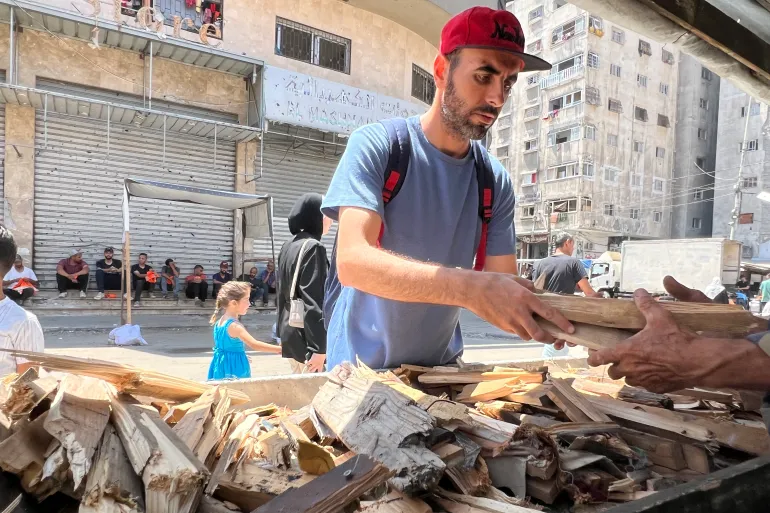
In Gaza, firewood is no longer just an alternative means of heating, cooking, or bathing; it has become a direct line between childhood and death.
In a winter without gas, without electricity, and without security, children emerge from displacement tents or the ruins of demolished homes, carrying small bags and empty hands, searching for pieces of wood, remnants of doors and furniture, or burnt trees to light a fire that will keep their families alive—or so they think.
But the occupation sees these children only as moving targets.
With the continued tight siege and the prevention of fuel and cooking gas from entering in the required quantities, thousands of displaced families have been forced to use firewood as their only source of heating and cooking.
Um al-Abd Ayesh, 46, displaced from northern Gaza to a camp in the central Gaza Strip, says: “For months, only one gas cylinder, with a capacity of just 6 kilograms, has entered. It was only enough for our family of eight for one month, and then we went back to cooking with firewood.” We boil water over firewood and warm ourselves by the embers, but it is our children who pay the price.
She adds, her voice hoarse, “I don’t send my son because I want to, but because if we don’t, we will die of cold or hunger. We can’t do without firewood when we don’t have the money to buy it from the market. A kilo of firewood costs about 6 shekels on average, which is equivalent to two dollars.”
The testimonies of the displaced converge on one fact: the targeting does not appear to be random, but rather recurs in known places and times, where children go out in small groups to collect firewood, often in open areas. Many families also rely on collecting firewood and plastic from destroyed homes and selling it, given the scarcity of money and the dire economic situation.
One of the most heartbreaking and tragic incidents occurred a few days ago near Kamal Adwan Hospital in northern Gaza, where two children, Muhammad al-Zawar’a and Suleiman al-Zawar’a, were killed by a direct strike from an Israeli drone while collecting firewood near their home in the vicinity of the hospital.
The children were not in a combat zone and were carrying only small bags of dry wood, which they used as an alternative fuel due to the complete lack of gas and electricity. The father was holding his son, crying out, “Call the doctor to wake them up!” According to medical testimonies and displaced people, the bombing killed both children instantly. The tragedy was compounded when it was revealed that Mohammed was his father’s only son, and Suleiman was his nephew. A heartbreaking video circulated on social media showing Mohammed’s father trying to wake him, saying, “My only son can’t die and leave me.” But death was the stark and unwavering reality for a child who had gone out seeking a glimmer of warmth.
One of the paramedics who arrived at the scene said, “The injuries were fatal; there was no chance of survival. The scene was more horrific than any we had ever seen.” The hospital was not a refuge, but a silent witness to the targeting of childhood and the collapse of the notion that proximity to a medical facility could offer protection.