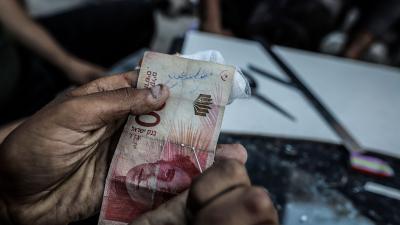
Money repair in Gaza: A profession born from the liquidity crisis
39
In Gaza’s markets, cash is no longer a reliable means of purchase. Often, it has become a daily burden, as many banknotes have lost their legal tender status due to war damage, bank closures, and the ban on new currency entering the Strip.
After nearly two and a half years of war, Gaza’s markets are overflowing with worn banknotes that vendors and shoppers refuse to accept. Merchants only accept banknotes after subjecting them to a simple inspection in sunlight to ensure they are free of holes.
With the scarcity of new currency, the circulation of certain denominations, such as the 10-shekel and 20-shekel notes, has declined. Meanwhile, banks have stopped exchanging old currency after more than 93% of their branches were damaged, according to a World Bank report.
With the declining quality of circulating currency, new professions have emerged. In the central market of Nuseirat camp, Umm Sharif repairs high-value banknotes for a few shekels to secure a daily income.
This phenomenon reflects the residents’ ability to adapt, as repairing banknotes has become a necessary means of maintaining circulation amidst the scarcity of cash and the lack of small change.
The difficulties don’t end with the deterioration of the currency. Residents also face high fees when withdrawing money received from abroad, reaching approximately 20%, and the remaining funds they receive are often worn and damaged.
In an attempt to alleviate the crisis, some residents have turned to electronic payments through banking applications. However, this option remains limited due to power outages and weak internet connectivity, which disrupt transfers and delay purchases.
With the continued ban on the introduction of new banknotes, the liquidity crisis deepens, and the rate of deterioration of circulating banknotes accelerates. The crisis transcends its financial dimension, impacting residents’ ability to access their money and secure their basic needs.