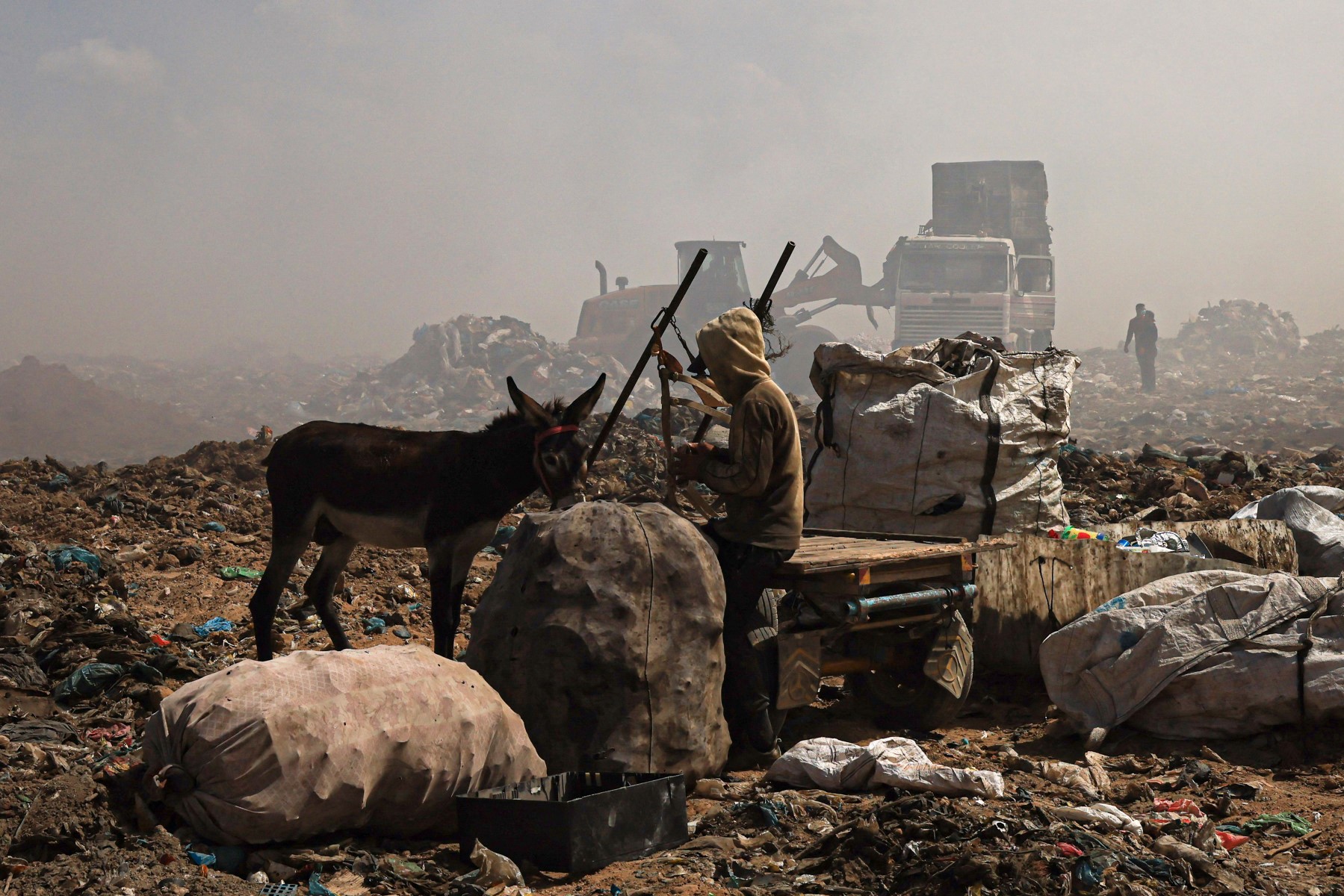
Gaza is caught between two wars: a frozen military one and an environmental one riddled with waste
801
With the first rays of dawn in Gaza’s pale sky, Jamal isn’t awakened by an alarm clock, but by the stench of decaying garbage that has become his daily calendar. He emerges from his dilapidated tent, his rough hand gently stroking the back of his emaciated donkey, as if apologizing in advance for the daily ordeal of collecting piles of trash. Then he ties his frail animal to a cart made of a wooden plank and two wheels.
“This is an environmental ambulance in a city devoid of any remedy,” Jamal says. “With this donkey cart, we’re trying to save Gaza from drowning in black garbage bags, after the collapse of the waste management system.” He pauses, then pulls his donkey along to begin his garbage-collecting journey, where the roar of compactor trucks has been replaced by the creaking of wooden wheels and the thud of weary hooves.
Between the tent encampments, where the collection and removal trucks never reach, Jamal bends his back, bearing the weight of displacement, and begins gathering the trash with his rudimentary tools. Bare-handed except for a few prominent veins, a bristling hand broom, and a broken plastic bucket, he lifts bag after bag… bags riddled with holes, oozing black fluid that stains his clothes and leaves a trail of bacteria and the unknown on his skin.
This primitive scene of Jamal’s work takes Gaza City back decades. In the heart of displacement camps, the carts have transformed from a simple rural means of transport into the last line of defense for Gazans’ survival. The worker adds, “The waste management system in the Gaza Strip has collapsed, and this represents a ticking time bomb threatening an unprecedented environmental and health catastrophe. The spread of garbage bags in the streets has created a complex situation that is difficult to control.”
Due to the war on Gaza, waste management operations ceased, and makeshift dumps emerged. This was not an organizational choice, but rather an inevitable consequence of the disruption of the waste management cycle. Garbage now litters the streets, which have been transformed from pedestrian and vehicular thoroughfares into open dumps.
The manual collection mechanism implemented by Jamal was forced upon Gaza municipalities after the waste management cycle was disrupted. Ali Al-Habil, Executive Director of the Joint Council for Solid Waste Management, says, “Israel destroyed the municipalities’ waste collection vehicles, equipment, and bulldozers, paralyzing the ability to transport waste from temporary collection centers to main landfills. The severe fuel shortage also prevents the operation of the remaining equipment, forcing residents and municipalities to rely on primitive alternatives such as animal-drawn carts, which are completely insufficient for the scale of the disaster.” He adds, “Due to the Israeli army’s deployment in Gaza, access to the main landfills, which are located in border or military areas, is impossible or dangerous. This leads to the spread of random dumps among residential neighborhoods. Municipal and joint council teams find themselves facing an impossible reality, and while trying to work with minimal resources, they face direct security risks.”