Palestinians live with constant pain… bullets and shrapnel in the bodies of Gaza’s wounded
424
Due to Israeli bullets penetrating their bodies and lodging there, coupled with the lack of or absence of medical equipment and resources to properly handle such foreign objects.
A bullet in the shoulder
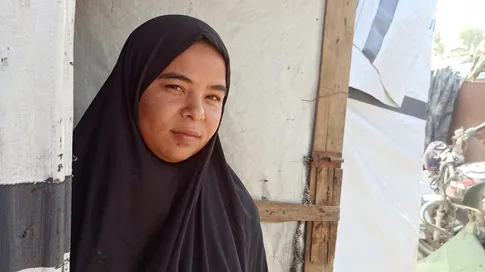
While sleeping in her tent with her displaced family near the beach in Khan Younis, in the southern Gaza Strip, 27-year-old Palestinian woman Suhair Saqr awoke in a panic, suffering excruciating pain from an Israeli bullet that had pierced her neck and lodged in her left shoulder.
Saqr stated that she immediately went to the nearby Red Cross Society hospital for treatment. However, the doctors, who decided to operate immediately, repeatedly explained to her that “removing the bullet poses a risk to her life because it is large and very close to the nerves. Removing it at this time would likely cause nerve damage and could lead to paralysis. They advised me to live with the bullet.”
She added, “The bullet causes me constant, severe pain. Sometimes I can’t move my hand, and there’s significant swelling in the area of the injury, which puts pressure on the nerves. I then feel pain and heaviness in my head and dizziness, and I can’t do anything except take painkillers.”
The young woman expressed her strong hope that she would be able to receive proper treatment in Gaza or travel abroad to have the bullet removed, as it constantly disrupts her life. She noted that she had met another young woman “who was shot, and the surgery to remove the bullet left her paralyzed.”
Shrapnel and Constant Pain
Sharab’s pain and suffering didn’t end with the loss of her loved one; they continued because of shrapnel from an Israeli missile lodged in her lower back. In an interview with Arabi21, she explained that doctors at the Gaza European Hospital (before it was stormed and destroyed by the Israeli army) “refused to remove the remaining shrapnel, telling us that the body might expel this foreign object or coexist with it, with fibrous tissue forming around it, and it would remain inside the body.”
She added, “Sometimes I experience severe pain and spasms, and I can’t move my back. I don’t know if this is caused by that shrapnel or other shrapnel that hasn’t been discovered yet.” She noted that she tries to live with it and forget about it, asking, “What else can I do?”
Due to the pain and spasms, Umm Muhammad went again to the Kuwait Hospital in the Mawasi area of Khan Younis for treatment. After the doctors examined her, they confirmed that they couldn’t do anything unless the shrapnel moved out and became visible.
Sharap noted that her husband, who was injured in the same bombing, had several shrapnel fragments removed by doctors. After his treatment was completed, during their recent displacement, he experienced severe headaches while sleeping. She took him to a nearby medical point, where an examination revealed a piece of shrapnel lodged in his head that doctors had previously missed. His body had managed to expel it, and the doctors successfully removed it.
Palestinian surgeon Imad Abed explained, “We remove some shrapnel, especially those near a major artery or those causing nerve irritation, while others we leave in, depending on their location and the level of danger they pose to the patient.”
He added, “The body adapts to the shrapnel left in the patient’s body.” He clarified, “Some bullets lodged in muscles can be left in, but those inside a joint must be removed. Therefore, whether to leave or remove a foreign object depends on its location within the patient’s body.”
Abed pointed out that “bullets or shrapnel that penetrate the human body are not removed if the harm caused by removing them outweighs the harm caused by leaving them in place.”
The Israeli occupation state has been waging a war of extermination against the Palestinian people since October 7, 2013, resulting in the complete destruction of many cities in the Gaza Strip.