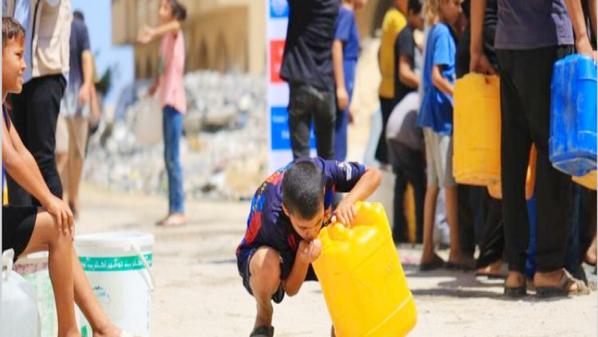
After two full months of water being cut off from her nearly destroyed home in the Al-Nasr neighborhood, west of Gaza City, Khadija Nabhan, in her thirties, turned on the kitchen tap, hoping to hear a sound that would quench her long-awaited thirst. She waited for the sound of flowing water, but the silence spoke volumes, and the dilapidated house remained captive to a heavy thirst that burdened every aspect of life.
In her home, piles of dishes and dirty laundry lay accumulating, waiting for water that hadn’t visited the house for weeks: “The water crisis is very difficult. A few days ago, I heard that a thin trickle of water had reached a line near my home, so I rushed there, and there I had a difficult and agonizing experience.”
Two hours of waiting yielded only two buckets of water, barely enough for her most basic needs. The woman whose husband was killed during the genocide has no one to help her in the arduous struggle to find a lifeline and cope with the burden of transportation. Her children are young. “My back is practically screaming with pain… I’m certain I’ve developed a slipped disc from carrying water and firewood over the past two years,” she adds bitterly.
For Nabhan, drinking water remains another burden. She buys it when she can afford it, or she waits for a truck distributing it for free, around which young and old crowd, barely managing to get a gallon or two.
Hundreds of meters south of the city, Muhammad Ubaid walks about a kilometer round trip from his tent of forced displacement, under the midday sun, to obtain some water whose salinity is almost like that of the sea.
He tells us, “I waited two weeks before I learned that a meager amount had arrived via a nearby pipeline. What I received after such a long wait isn’t suitable for food or washing, but having it is better than not having it at all.”
The Gaza Municipality, for its part, confirms that the crisis is worsening, particularly with the disruption of the Mekorot water pipeline. It explains that the deficit has reached 90% of the total daily need compared to pre-war levels.
Eng. Tariq Shehab, an official in the municipality’s water department, stated in a press release: “The municipality is trying to bridge the gap by operating its own wells and increasing the operating hours of the remaining wells to provide a minimum supply to some areas.” He called for allowing municipal crews access to the eastern areas to inspect and maintain the Mekorot pipeline and to bring in the municipality’s urgent needs, including cement, pipes, maintenance materials, machinery, spare parts, and pumps.