Gaza’s most parched summer in history: Searching for a sip of water
717
In Al-Mawasi area west of Khan Younis, the story of the day for 10-year-old Ahmed Saqr doesn’t begin with the sunrise, but rather with the weight of the empty brown water cooler he carries. “My mother is looking for water, and I’ve been thirsty for two days,” Ahmed says in a few words that belie his exhaustion. A single glance from the child is enough to convey the magnitude of the tragedy; his sunken eyes and thin frame tell the story of a drought ravaging the bodies of two million Palestinians.
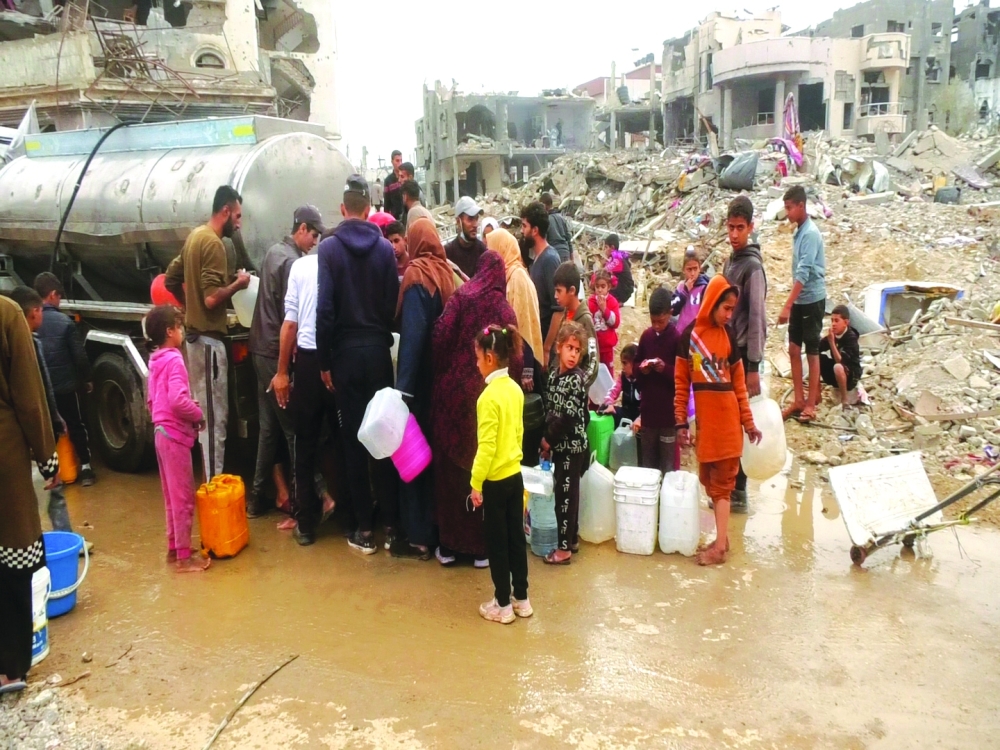
Nearby, Fatima, 35, sits cradling her infant, who is suffering from the sweltering heat. The mother doesn’t hide her anger mixed with helplessness: “We get water only once a week, and we have to beg the neighbors for a little. The situation is unbearable, and I’m forced to drink contaminated water because it’s the only way to survive.” In the background, displaced people crowd around a meager water distribution point, while the stench of sewage permeates the air, a testament to the complete absence of any infrastructure maintenance. With the arrival of summer 2026, when temperatures exceed 35 degrees Celsius, displaced families cannot afford the luxury of precise calculations. Each individual receives between 3 and 15 liters of water daily, whereas the pre-war average exceeded 84 liters. UNICEF data indicates that half of the families in the Gaza Strip currently rely on just six liters a day to meet all their drinking and cooking needs.
These figures are not mere statistics; they reflect the collapse of an entire system. Data from the Gaza Municipality confirms that 85% of the Strip’s residents are deprived of clean water, amidst a water supply deficit approaching 90%. Instead of the Strip’s estimated daily need of 100,000 cubic meters, only 12,000 cubic meters are actually available.
Faces of the Crisis: “Thirst Added to the Siege” In a scene that repeats itself under the scorching summer sun, thousands of displaced people line up in endless queues, hoping to obtain a few liters of water. To cope with the summer heat, which officials have described as the most parched in the history of the sector, unless the international community exerts strong pressure on the occupation to force it to allow sufficient entry of fuel, maintenance equipment and spare parts.